Kern High School District Pharmacy Technician Program
At CTEC in Bakersfield, high school seniors can take pharmacy technician classes during the day or in the evening. Adults can enroll in the evening track for $1,800. Both tracks offer eligible students a chance to train in a local pharmacy during the second semester.
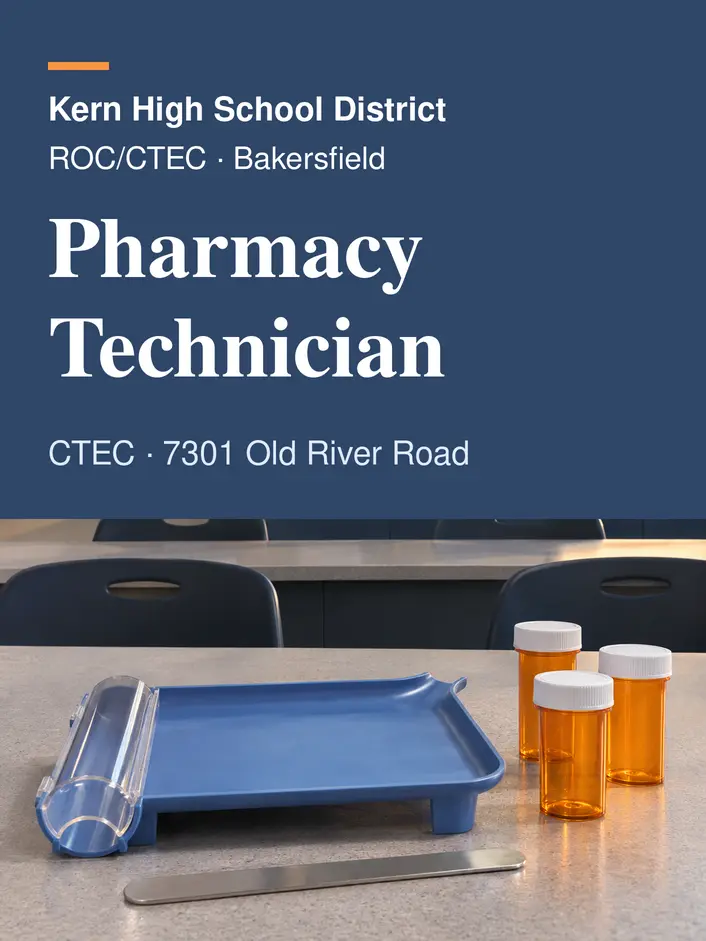
Daytime or Evening Pharmacy Tech?
Both tracks are taught at the Career Technical Education Center (CTEC), part of Kern High School District’s ROC/CTEC career education program. For a high school senior, the choice changes when class takes place and how many credits it adds to the high school transcript. For an adult, the evening track is the district’s pharmacy option.

Both tracks meet the UC and CSU area G requirement, the college-preparatory elective category. CTEC points juniors toward Introduction to Health Careers, a separate course they can take before senior year.
Applying for the 2027–28 Evening Program
KHSD posts separate forms for adults and district students. Adults start with the evening interest form. Current KHSD students applying for a senior-year seat use the student application.
KHSD student application opens at 8 a.m.
Adult interest form opens at 8 a.m.
Evening classes begin. The district’s school year ends May 11, 2028.
For work and transportation planning, KHSD’s general evening schedule is Tuesday through Thursday, 5:30 to 8:30 p.m. for most classes. Those hours describe the district’s evening schedule as a whole. The pharmacy course listing gives no separate class times.
KHSD evening applications and dates
What Adults Pay
The $1,800 is the district’s published program fee for the evening pharmacy technician course. High school students in the evening track attend at no charge. For adults comparing this course with private colleges, the fee buys a school-year schedule at CTEC with a chance at an internship during the second semester.
California licensure and the PTCB certification exam have their own fees. The PTCB charge applies if you pursue that credential. Those two expenses depend on the route you take after training.
| Charge | Amount |
|---|---|
| KHSD adult evening program | $1,800 |
| California license application | $120 |
| PTCB certification application and exam | $129 |
What the Pharmacy Math Looks Like
The district expects students to read instructions accurately, multiply and divide fractions, and handle basic conversions. In class, those skills meet pharmacy vocabulary. A prescription practice exercise might ask a student to keep the quantity and unit together while reading an order and entering it into a record.
Try a fraction example
One practice container holds half a liter of water. How much do three containers hold? Add three halves to get 3/2 liters, or 1½ liters. The unit stays liters after you add the quantities.
Try a metric conversion
A practice measuring cup is marked 250 milliliters. Four equal cups hold 1,000 milliliters, or 1 liter. The number changes when you convert the unit. The amount of liquid stays the same.
KHSD also teaches what the common medication names refer to, how prescription orders are written, and why pharmacies keep careful records. Students learn the technician’s role in preparing orders and the pharmacist’s role in reviewing them.

Second-Semester Training in a Local Pharmacy
CTEC teaches the classroom portion. In the second semester, students who meet the district’s conditions may train in a local working pharmacy. In that setting, a routine order is part of a longer process involving records, inventory and a pharmacist’s review.
For internship consideration, KHSD requires students to be 18 by the start of the internship, have a valid Social Security number, obtain California Department of Justice fingerprint clearance, and pass a drug screen.
The birthday requirement matters most for high school seniors. A student can qualify for senior-year classes while still 17. If their 18th birthday falls after the internship begins, they miss the age requirement for that start. The same conditions apply to the daytime and evening internships.
On the daytime track, the class also covers inventory management. Students can connect that topic to what happens in a real pharmacy when stock arrives, products are shelved, or an order needs to be filled from available stock.

From CTEC to a California License
KHSD’s daytime course describes preparation for both California licensure and the national PTCB exam. The evening listing describes coursework and the internship and leaves out the course-hour and affidavit details needed to establish a training route. The district’s general evening calendar cannot establish those facts for this individual course.
School Certificate, State License, National Exam
A school certificate documents course completion. A California pharmacy technician license comes from the State Board of Pharmacy. For the Board’s 240-hour training route, the provider must meet the state’s training standards and document completion. The Board also accepts eligible national certification as a separate route.
The PTCB has its own exam eligibility rules. Its recognized training and qualifying work experience pathways are defined separately from the state’s coursework route.
Pharmacy technician certification and licensingOther Bakersfield Programs for Adults
KHSD is the lowest published adult fee among the programs in this comparison. The 2027–28 evening intake follows the district school year. The other programs offer different ways to fit training around a job or other commitments.
A Public University Evening Option
CSU Bakersfield Extended Education organizes its certificate into three evening courses. The supervised pharmacy part comes in the final course. The published estimate is about $6,875 including books, supplies and the application fee.
A Choice of Day or Evening Classes
High Desert Medical College offers adults a 34-week daytime option or a 42-week evening option. Both include 160 hours of supervised pharmacy training. It’s the direct local comparison for an adult who needs daytime classes.
Blended Coursework and Campus Practice
Carrington’s Bakersfield program combines online coursework with campus practice and 120 hours of supervised pharmacy training. It publishes a program length of about 36 weeks before breaks, so the calendar is measured differently from CTEC’s two semesters.
Students who want to spend more of their training in direct patient care can compare Bakersfield vocational nursing programs. Nursing clinical rotations center on patients’ day-to-day care. Pharmacy technician practice centers on prescription orders, inventory, and preparing medication for review.