High Desert Medical College · BakersfieldPharmacy Technician Program
At HDMC’s 24th Street campus, the daytime schedule runs 34 weeks and the evening schedule runs 42. Both lead to the same certificate and include 160 hours of supervised practice in a working pharmacy.
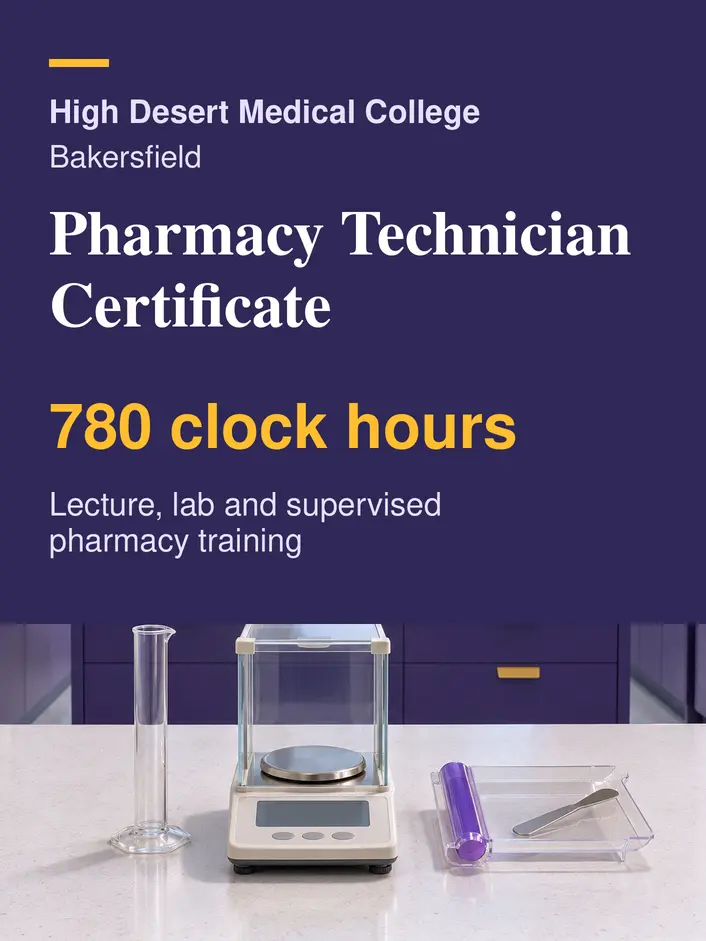
- Daytime or evening
- 34 or 42 weeks
- Classes, labs and supervised training
- 780 hours
- Published program cost
- $20,121
Daytime or Evening Classes?
The two schedules cover the same coursework. The evening option spreads it over eight more weeks. HDMC offers on-campus and hybrid instruction. Hybrid combines online coursework with campus labs and in-person pharmacy training.
The two lengths describe the published calendar. Students still need to finish their classes, labs and hours at a pharmacy site to earn the certificate. Someone planning around a daytime job can compare the two pieces of the schedule separately. The evening calendar can work for class and lab, but 160 hours in a pharmacy still have to fit around the workweek.

What You Learn in Class and Lab
The technical curriculum has seven courses. Two career development courses follow a separate sequence. The certificate carries 35 semester credits. Those credits describe the coursework, while the 780 clock hours describe time spent in class, in the lab and at a pharmacy site.

Pharmacy Basics and Drug Fundamentals
In PHR100 and PHR101, students learn the technician’s role and build a vocabulary for discussing medications and reading pharmacy information. PHR102 adds medical terminology, anatomy and physiology. Those subjects help make sense of the language used in both pharmacy records and the later pharmacology course.
How a Pharmacy Operates
PHR103 and PHR106 cover pharmacy operations and practice management. That work includes processing prescriptions, working with inventory and records, and understanding the responsibilities that keep orders moving through a pharmacy. These are parts of the job that happen alongside preparing medication.
Pharmacology and IV Preparation
PHR104 focuses on pharmacology. PHR105 introduces IV preparation in the instructional lab. Students encounter a different set of equipment and standards from what they use in the regular prescription-processing lab. The IV course belongs to the certificate curriculum and introduces skills relevant to institutional pharmacy work.
Career Development and Course Prerequisites
CD100 comes before CD200. The two career development courses account for 60 lecture hours. The seven pharmacy courses each have 45 lecture hours and 35 lab hours, and students complete all seven before the supervised pharmacy course, PHR107.
From Practice Lab to Working Pharmacy
Students spend 620 hours in classes and labs before the last 160 hours of the certificate. HDMC calls the supervised workplace portion an externship.
- Lecture
- 375 hours
- Lab practice
- 245 hours
- Supervised pharmacy training
- 160 hours
The 160 hours amount to four 40-hour weeks or eight 20-hour weeks. Those figures show how much time to budget. The actual work schedule depends on the site arrangement.
In a working pharmacy, students apply what they practiced in class under a site supervisor. That can include processing orders, preparing medication for a pharmacist’s review, and following the site’s procedures for records and inventory.
The school’s coordinator works with students on site arrangements. HDMC’s catalog allows assignments as far as 100 miles from campus, and students provide their own transportation. A signed agreement and weekly records signed by the supervisor document the hours.

What the $20,121 Covers
Tuition is $17,135. The rest of the published program cost covers registration, books, lab materials, and other school charges. The $200 nonrefundable registration fee is part of the published total.
| Tuition | $17,135 |
|---|---|
| Registration | $200 |
| Books and Workbooks | $415 |
| Lab Fees and Supplies | $1,590 |
| Malpractice Insurance | $150 |
| Uniforms and Student ID | $75 |
| CPR | $85 |
| Technology | $471 |
| Total Program Cost | $20,121 |
Tuition and required program charges make up the school bill. Transportation, personal equipment and expenses such as rent or child care belong in a separate budget. That distinction matters when comparing a school’s published charge with a financial aid estimate that includes living expenses.
The catalog lists two scrub tops, two pairs of scrub pants, six books, a student ID, a CPR card and a diploma among the items supplied through the program. Uniform shoes, a watch with a sweep second hand, a pen, and travel to the pharmacy site are separate expenses. The California license application and any national certification exam have separate fees.

How HDMC Compares With Other Bakersfield Programs
At $20,121, HDMC is close in price to Carrington and costs more than the two public programs. The class schedule and the timing of supervised pharmacy training also differ by school.
From the HDMC Certificate to a California License
HDMC awards the school certificate. The California State Board of Pharmacy issues the license you need to work as a pharmacy technician in California. National certification is a third credential, earned through a separate application and exam.
HDMC Certificate
HDMC awards a Certificate of Completion after you finish the required courses, labs and supervised pharmacy training. If you apply for your state license through the qualifying training route, the Board’s application calls for a training affidavit completed by the school.
California License
The Board accepts several ways to qualify, including eligible school training or national certification. Applicants also submit proof of high school completion or an equivalent credential and provide fingerprints for a background review.
California license applicationNational Certification
HDMC describes its coursework as preparation for the Pharmacy Technician Certification Exam. The Pharmacy Technician Certification Board awards its CPhT credential to applicants who meet its eligibility requirements and pass the exam.
PTCB exam and eligibilityAdmission and Paying for School
Applicants generally need a high school diploma or GED and an admissions interview. The catalog allows enrollment at 17 with a parent’s signature. HDMC’s program information lists no prior pharmacy coursework or experience as a requirement.
The school catalog also requires students to read, write, speak and understand English. The coursework puts that to use early in the program through medication terminology, written instructions and pharmacy records.
Grants and Loans
HDMC lists federal and state aid options that may be available to eligible students, including Pell Grants, federal Direct Loans and Cal Grants. A grant can reduce the portion of the bill financed with loans. A loan pays school costs up front and creates a repayment obligation. In its 2024 Bakersfield disclosure, HDMC reported that 73% of students in this program received federal loans and reported average federal loan debt of $15,257.
Attendance and Withdrawal
The catalog sets a minimum attendance requirement of 80% for graduation. Its cancellation policy allows eligible students to cancel by the first class or the seventh day after enrollment, whichever is later. Withdrawals after that period follow the catalog’s refund policy.
Campus Contact
High Desert Medical College, 2000 24th Street, Bakersfield, CA 93301. The campus telephone number is (661) 579-2901.
Pharmacy Technician or Vocational Nurse?
HDMC offers both programs in Bakersfield. The difference is easiest to see in where students train and what they do there.
Pharmacy Technician
In the lab, students practice processing prescriptions, working with inventory and preparing medication for a pharmacist’s review. HDMC includes 160 hours of supervised training in a working pharmacy, where students put those skills to use.
Vocational Nurse
In clinical rotations, students spend time providing basic patient care under supervision. That includes taking vital signs and helping patients with everyday care. The HDMC Bakersfield vocational nursing program has its own class and clinical schedule.