Pharmacy Technician Programs
Find training by state or near a ZIP code, then compare coursework, supervised pharmacy training, and total cost.
Search Programs
Find training by state or near a ZIP code, then compare coursework, supervised pharmacy training, and total cost.
Search ProgramsA pharmacy technician program can be a noncredit course, a college certificate or degree, or training you complete through a job. Compare what you’ll earn on completion, where you’ll practice, and which route fits the state where you plan to work.

A hospital program may mix classroom instruction with rotations in inpatient or outpatient pharmacy. Community colleges may offer daytime or evening classes with pharmacy placements. Career and technical education programs can be an option for eligible high school students, and some public adult education programs teach the same occupation on a separate schedule. Admission criteria and who can participate in practice hours vary by program.
A hospital program and a paid retail training role can both lead into pharmacy technician work, with different routes through training. In an employer route, look at the trainee shifts and whether instruction happens during scheduled work time. In a school route, compare the dates of the lab and the supervised placement with your work and transportation schedule. A paid apprenticeship can offer classroom instruction and on-the-job learning together, so compare the sponsor’s actual work site and training plan.
The duration on a program page describes its schedule. A cohort may start once or twice a year, a self-paced program may give you a deadline to complete the material, and a clinical placement may follow a different calendar. Use the start date and the pharmacy placement dates when estimating when you could finish. See the pharmacy technician training routes for how those steps fit into the path to work.
A syllabus is more useful when it shows classroom, simulation, and supervised pharmacy hours separately. They give you different kinds of practice.

Pharmacy calculations, medication names and dosage forms, pharmacy law, inventory, and insurance processing are common topics. In a prescription exercise, you might work out days’ supply, recognize a discrepancy, and decide when the pharmacist needs to review an order.
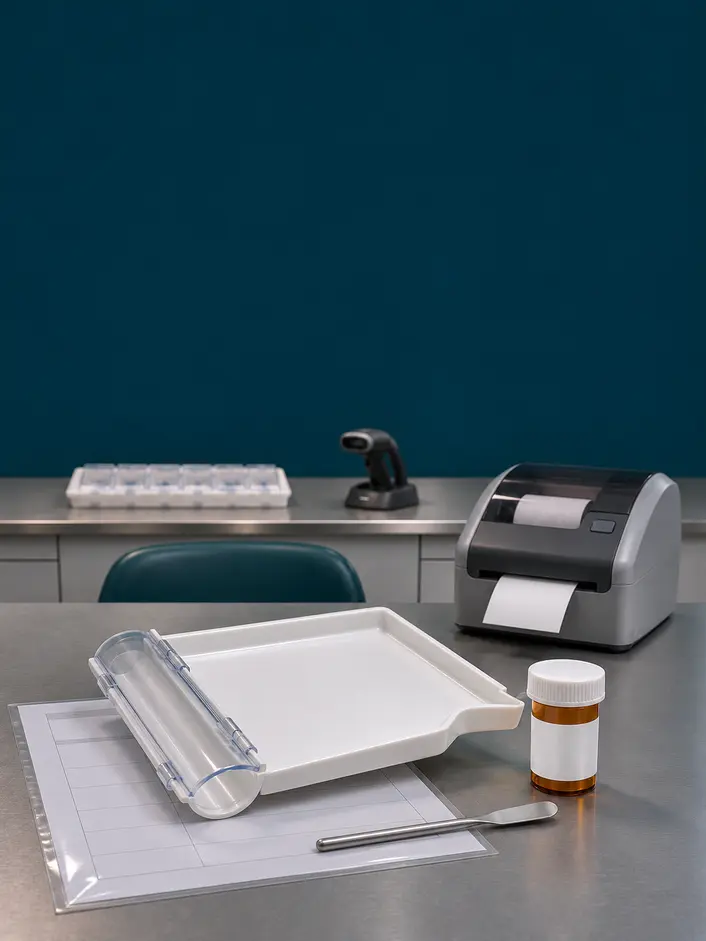
In a practice lab you can use a counting tray, scan a stock bottle, enter a simulated order, and match a label to a container. The format can vary, from scheduled campus labs to instructor-led virtual sessions or practice kits.
In a placement, you work within the site’s rules and learn how a working pharmacy handles prescriptions, inventory, privacy, and handoffs. Programs may call this an externship, rotation, or experiential training. The site and supervisor shape what you can do.
Two programs with the same total hours can divide their time differently. One might emphasize a community pharmacy rotation, while another includes inpatient distribution or sterile compounding simulation. If the schedule lists only the total, look for the course outline and placement handbook. The ASHP/ACPE accreditation standards publish the training standards and effective dates, including the revision effective January 1, 2027.
Virginia Commonwealth University lists 160 hours of self-paced online coursework, 80 hours of scheduled live and virtual simulation, and 160 hours of experiential training. The lecture hours, scheduled simulation and work at a pharmacy each make a different demand on your time. If you work during school, the self-paced section may fit around your job while the live sessions and pharmacy shifts require fixed blocks of time.
For a hospital rotation, look at which assignments are available to students. Inpatient preparation and distribution can involve different routines from a community site that handles pickup and insurance claims. The placement schedule and duties tell you more about that experience than the word “clinical” on a program page. VCU training schedule and hours
Coursework can be fully online. A program advertised that way may still have scheduled labs or supervised practice at a pharmacy. Those details also affect whether you can complete the program from your state.
An exam preparation course can fit around work and help you study topics such as medication safety and calculations. Some options stop at coursework. If that’s the case, the course may suit someone who already has a separate training or work-experience route. Compare the program’s exact name with the certifier’s directory before applying through an education pathway.
Some programs teach online and require supervised hours at a pharmacy. Read the placement policy for who arranges the site, where sites are available, and what happens if a site declines a student or has a waiting list. Travel and daytime shifts can change the cost and schedule even when classes are self-paced.
A hybrid course combines remote instruction with scheduled in-person work, which may include a lab, a placement, or both. Plan around the dates and locations for each. A program may also have live virtual sessions with fixed attendance times even if most lessons are available on demand.

A provider can offer multiple pharmacy technician tracks with different training hours and placement terms. The tuition page, curriculum, and school catalog may describe different editions or campuses. Match the course title and delivery option across all three. If a provider advertises a placement partner, use its written terms to see what support comes with your enrollment and who is responsible for securing a site.
For example, Penn Foster’s Pharmacy Technician Professional track lists a 160-hour supervised pharmacy placement within a program that teaches coursework online. That is four 40-hour weeks as a time comparison. A site may schedule it differently. Before comparing the completion time with another program, account for the site’s schedule and any wait between finishing coursework and starting the placement. Penn Foster Professional training format
Read state eligibility and placement rules before paying. A school may enroll students in a state where placement options are limited, and a provider’s listing in a national directory does not establish state approval. If you’ll complete coursework from one state and work in another, use the requirements for the state where you plan to work.
Search Local and Online Programs
Florida’s registration instructions list completion of a board-approved training program. A national exam study course can be useful preparation, but you still need a program that satisfies Florida’s training requirement if you intend to register there. When a provider runs multiple tracks, match the campus, course name and format to the approval that applies. A school may have one track designed for the approval and another focused on exam preparation. Florida pharmacy technician registration requirements
A directory result with an accreditor-listed address identifies a location published in that directory. Use the provider’s program information for where classes are taught and where pharmacy hours are completed. This is especially useful when a college has several campuses or when the training is administered through a hospital system with several sites.
Compare the cost of finishing each program. The tuition figure may leave out books, scrubs, lab supplies, an exam voucher, registration, or travel to a pharmacy placement.

Community and technical colleges often charge by credit and may offer lower tuition to in-district students. A program’s full bill may include course fees and supplies. Compare the residency rate that applies to you and when the required courses and placements are offered.
Some private schools offer frequent start dates, accelerated schedules, or placement support. Compare the full price, the placement policy, and any extra fee for extending access to a self-paced course. If there’s a payment plan, compare the total paid across all installments with the price for paying upfront.
For paid training, compare the trainee wage, the schedule, and when the regular technician rate would begin. Read the employer’s training support terms for books, credential fees, and exam costs. The pharmacy technician salary guide gives wage context by state and work setting.
Use the school’s aid page for the specific program and term. Federal student aid, workforce funding through an American Job Center, employer sponsorship, and approved military or veterans benefits have different eligibility rules. Some of those options may cover tuition without covering every fee. Start with the provider’s full cost sheet and put the costs you’ll pay yourself in a separate subtotal.
Pima Community College publishes an estimate for its pharmacy technology certificate that separates tuition from books, course materials, supplies and equipment. It specifies the year and the in-state, full-time basis for the estimate. Use the same basis when comparing a public college’s figure with a private school’s bundled price. An exam voucher, lab kit or required screening may be included in one quote and separate in the other. Pima pharmacy technology cost breakdown
Allow for the weeks when you might work fewer paid hours. For example, an evening class can fit around a day job while a daytime pharmacy rotation overlaps with it. The start date, expected hours per week, and travel distance to the site can matter as much as the difference between two tuition quotes.
Look for an itemized refund policy before paying a deposit. A self-paced program may measure the refund period from enrollment, while a college may use the start date for each term. If supervised training happens later, find out what payments are due before a site is assigned. These dates matter when you’re choosing between a program that starts immediately and one with a later cohort.
State searches include listings with limited location details. ZIP searches use documented locations and approximate straight-line distances from ZIP centers.